The need for engine repair in Ogden often begins with a few warning signs. A persistent knock at idle, white smoke, or coolant loss may indicate an internal engine problem. A check engine light may also identify a misfire that requires further testing.
Arnold Auto Repair diagnoses and repairs engine faults on Ford, Chevrolet, GMC, RAM, Toyota, and Honda vehicles. We also service other domestic and imported vehicles driven throughout Weber County.
Our repair services include head gasket replacement, timing chain and timing belt work, valve cover gasket repairs, engine mount replacement, and cylinder head repair. When a compression test confirms internal damage, we may recommend a full engine rebuild or long block replacement. Every diagnosis starts with a written estimate before any teardown or parts order, so you approve the direction before we commit.
Qualifying repairs are backed by our warranty. Engine repair costs in Ogden, UT, depend on whether the job involves a bolt-on gasket or an internal rebuild. We confirm the repair scope before work begins. With 28 years in business at 1401 Wall Avenue, we serve drivers commuting into Ogden from Harrisville, North Ogden, West Haven, and the wider Weber County area.
A failed head gasket typically shows up as white exhaust smoke, coolant disappearing without a visible leak, or oil turning milky on the dipstick. The failure point is usually between the combustion chamber and a coolant passage, often accelerated on high-mileage domestic trucks that have run hot even briefly.
Head gasket repair on Ford, Chevrolet, and Ram vehicles involves removing the cylinder head. If it is warped beyond specification, we resurface or replace it. We then install a new gasket and torque the head bolts in the proper sequence. We confirm the failure with a cooling system pressure test and a block test for combustion gases in the coolant before quoting the job.
Timing chain replacement may be necessary when a stretched chain triggers a correlation code. It may also be needed when worn guides and tensioners cause rattling during a cold start. If not addressed, a slipped chain can bend valves and turn a timing repair into a full cylinder head repair or rebuild.
We inspect the guides, tensioner, and cam phasers instead of reusing worn parts. During reassembly, we reseal the front cover with the correct gasket and torque the fasteners to specification.
Engine knock repair starts by identifying the source of the sound. A rod knock deep in the block sounds different from a lifter tick or timing chain rattle. A compression test and leak-down test help isolate the affected cylinder and failed component. Depending on the test results, we may need to inspect the piston rings, crankshaft bearings, or engine block.
If the internal damage is confined to one cylinder and the block is still within spec, an engine rebuild service can be the right call. If the block is scored or a crankshaft journal is damaged, a long block replacement is usually the more honest recommendation.
Valve cover gasket leaks show up as oil weeping down the side of the cylinder head, often onto exhaust manifolds where it produces a burning smell. Valve cover gasket replacement addresses external oil leaks that may affect ignition components or wiring.
Worn engine mounts create a solid clunk on shifts and vibration at idle, which drivers often mistake for a transmission issue. We check mount condition during any engine service and replace them as a set when one has collapsed.
Engine repair is one part of our broader engine diagnostics work at Arnold Auto Repair. If the fault is in the fuel system rather than the engine’s mechanical components, we route the job to fuel system repair and cleaning. This approach avoids unnecessary engine disassembly.
Severe knocking, overheating, an oil-pressure warning, or a continuously flashing check engine light may require you to stop driving. Pull over safely and contact our team to determine whether the vehicle should be driven or towed.
A deep, rhythmic knock that changes with engine RPM usually points to worn crankshaft bearings or a failing connecting rod. A lighter tick from the top of the engine is more often a lifter or a stretched timing chain. High-mileage Ford and Chevrolet trucks are common on I-15 and US-89 commutes. Sustained highway speeds can accelerate bearing wear when oil change intervals are extended. Repeated heat cycles weaken the oil film that protects the crankshaft journals.
White smoke that remains after warm-up, along with a sweet coolant smell, may indicate a leaking head gasket. The leak can allow combustion gases into a coolant passage or coolant into a cylinder. Continuing to drive risks hydrolocking the engine and bending a connecting rod.
If the oil level drops without an obvious leak, the engine may be burning oil or leaking it where it is difficult to see. Worn valve seals, failed piston rings, or a cracked PCV diaphragm are the most common causes. A compression test with a wet-and-dry comparison helps confirm the source.
A misfire that continues after replacing the plugs, coils, and injectors usually points to a mechanical fault. Possible causes include a burned exhaust valve, bent pushrod, or low compression from ring wear. At this point, check engine light diagnostics may lead to a mechanical inspection. A compression test then helps determine the next step.
Oil in the coolant reservoir, coolant on the dipstick, or bubbles in the radiator on a running engine all indicate an internal breach between the two systems. The source is usually the head gasket, a cracked cylinder head, or in rare cases the engine block itself.
We start by asking when the symptom appeared, how it changes with RPM or temperature, and what has already been replaced in an attempt to fix it. That conversation shortens the diagnostic path before the vehicle goes on the lift.
Diagnostics may include a compression test, leak-down test, and cooling system pressure test. When we suspect a head gasket problem, we also perform a block test for combustion gases in the coolant. We confirm the specific failure before quoting anything.
You receive a written estimate identifying the failed component, the parts required, the labor hours, and the total. Nothing is disassembled or ordered without your sign-off.
We perform the work using OEM or OEM-equivalent parts and torque every fastener to specification. We also follow manufacturer procedures for head bolt sequences, timing marks, and break-in oil when applicable.
After reassembly we road-test the vehicle, recheck for leaks and verify the correct operating temperature, and document the work. You leave with the repair paperwork and the warranty terms in writing.
Ready to schedule your engine repair?
Service categories
Get a free quick solution
Engine repair cost in Ogden, UT, depends entirely on scope. Valve cover gasket and engine mount repairs generally cost less than internal engine repairs. A head gasket or timing chain repair typically falls in the middle. A full engine rebuild or long block replacement costs more because of the parts, labor hours, and machine shop work required for the cylinder head or engine block.
Because scope drives price so heavily, we do not quote a flat number over the phone. A compression test and visual inspection come first, and the written estimate follows before any teardown begins.
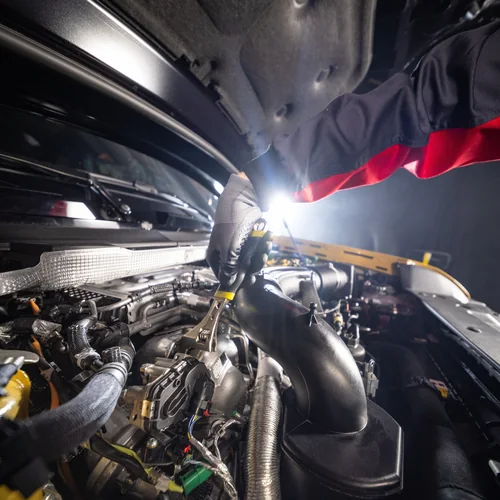
Every engine repair at Arnold Auto Repair starts with a written estimate. Before approving the work, you will know the failure point, required parts, and cost. We use OEM or OEM-equivalent parts, and our ASE-certified technicians follow manufacturer torque specs and procedures on every reassembly.
Qualifying repairs are backed by our warranty, and we offer loaner vehicles and a courtesy shuttle so an engine repair does not sideline your week. Early drop-off and secure after-hours pick-up are available, and financing through Synchrony Car Care and SurePay Finance helps larger repairs fit a real budget.


Arnold Auto Repair at 1401 Wall Avenue serves engine repair customers across Ogden, Harrisville, North Ogden, West Haven, Layton, Kaysville, Farmington, Bountiful, Brigham City, Huntsville, and Syracuse. Daily I-15 commuting exposes timing components and head gaskets to more heat cycles than local-only driving. The added mileage contributes to the internal wear patterns we often see. Most diagnostic work is completed within one business day, with the repair timeline confirmed once the failure is identified.
A compression test and a leak-down test decide the direction. If the block and crankshaft are within spec and the damage is limited to a gasket, timing component, or one cylinder head, repair is the right call. If the block is scored, a crankshaft journal is damaged, or multiple cylinders show low compression, long block replacement is usually more honest than chasing individual repairs.
Common signs include a persistent knock or tick, white exhaust smoke, and coolant loss without a visible leak. Other signs include oil loss between changes, oil mixing with coolant, or a rough idle that new plugs and coils do not fix. Any one of these is a reason to stop driving and have the engine checked before more damage happens.
A valve cover gasket or engine mount job may take one day. A head gasket or timing chain replacement usually takes two to four days. A full engine rebuild or long block installation may take up to a week. We confirm the timeline in writing with the estimate.
Often yes, if the rest of the vehicle is in good condition. A head gasket repair or timing chain replacement on a 150,000-mile truck is usually far less expensive than buying a replacement vehicle. A properly rebuilt engine can add another 100,000 miles of service life. We give an honest read on whether the repair makes financial sense before recommending it.
Ignoring engine damage leads to complete engine failure, and catching it early is the difference between a repair and a replacement. Call Arnold Auto Repair to get the diagnosis right the first time and a written estimate before any work begins.