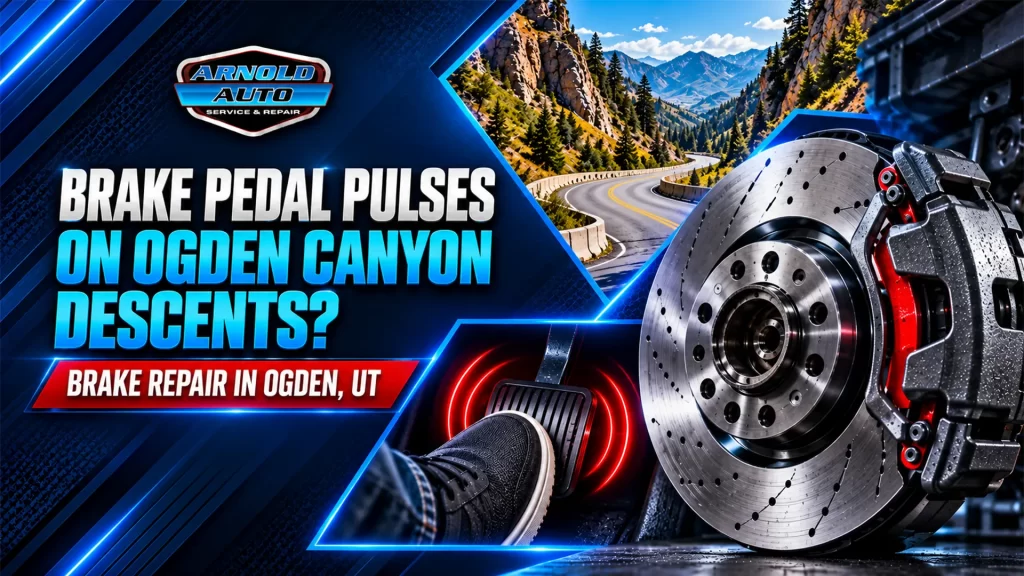
A brake pedal pulsation that appears during an Ogden Canyon descent often points to uneven friction at the brake rotors. The pulse can become stronger as repeated braking adds heat. At Arnold Auto Repair, our brake repair in Ogden, UT, includes checks of the pads, rotors, calipers, fluid, and ABS system.
A pulse does not prove that a rotor is simply “warped.” Thickness variation, runout, pad deposits, a sticking caliper, or ABS operation can feel similar. Measurements separate them.
Why Brake Pedal Pulsation Gets Worse Downhill
Brake pedal pulsation often becomes easier to feel downhill because the braking system must turn more motion into heat. Ogden Canyon adds repeated speed changes, curves, and a sustained grade. Those conditions can reveal a problem that stays subtle during flat driving around Wall Avenue.
Rotor Thickness Variation and Runout
A rotor should pass between the brake pads with a consistent surface and thickness. If its thickness varies, the pads move in and out as the wheel turns. That motion can travel through the hydraulic system and reach your foot as a repeating pulse.
Lateral runout means the rotor moves slightly from side to side. It can come from the rotor, corrosion at the hub, improper wheel fastener torque, or another fitment issue. Heat spots and pad deposits can also change friction.
Heat and Vehicle Load
Heat can amplify small rotor or pad differences. A loaded family SUV, work truck, or vehicle carrying outdoor gear asks the brakes to manage more energy on the way down. A dragging caliper can add even more heat to one wheel before you press the pedal.
The descent may not have caused the defect. It may have exposed an existing condition. Tell our shop if the pulse grows with heat and fades after cooling.
What the Pulsation Can Tell You
The location, rhythm, and timing of the vibration can narrow the inspection. Note where you feel it, the speed range, and whether it changes after the brakes warm up.
Pedal Pulsation Versus Steering Wheel Shake
A pedal pulse often tracks a brake-system variation. Steering wheel shake during braking may place more attention on the front rotors, hubs, steering, or suspension. These clues guide testing but do not replace measurement.
A wheel or tire problem can shake the vehicle even when you are not braking. Vibration that begins only with pedal pressure points more strongly toward the braking system.
Mechanical Pulsation Versus ABS Operation
ABS operation usually feels like a rapid pedal chatter during hard braking or when a tire is close to losing grip. A steady, repeating pulse during an ordinary dry-road stop is more consistent with a rotating mechanical variation.
An ABS warning light, unexpected activation, or dry-road chatter needs electronic diagnosis and a physical brake check. We can review wheel-speed data and stored codes.
What to Do During an Ogden Canyon Descent
Reduce speed early and avoid building more heat than the brakes need to handle. The Utah mountain-driving guidance advises drivers to choose a safe speed, use proper braking techniques, and select a low gear on steep descents.
Control Speed Before the Grade Builds
Select an appropriate lower gear or driving mode before speed rises, following your owner’s manual. Leave room to brake smoothly, and do not coast in neutral. Engine braking does not replace working service brakes.
If your brake pedal pulses downhill, avoid testing it with repeated hard stops. Continue only if the vehicle remains controllable and the braking response stays normal; then arrange an inspection soon.
Know When to Stop Driving
Move to a safe turnout and stop if braking weakens, the pedal becomes soft or sinks, the vehicle pulls sharply, or smoke appears. A strong burning smell, grinding, or a red brake warning light also calls for roadside help.
Do not touch a wheel or brake part after a hot descent. These parts can cause serious burns, even when they no longer look hot.
How We Diagnose Pulsing Brakes
We diagnose pulsing brakes by reproducing the concern safely, inspecting the complete system, and comparing measurements with vehicle specifications. Arnold Auto Repair does not need to assume that every pulse means the same repair.
Measurements Before Parts
We check pad wear, rotor condition, caliper movement, and the hub surface. A micrometer reveals thickness variation. A dial indicator measures lateral runout and helps show whether the rotor or hub needs attention.
If an ABS light or unexpected pedal chatter is part of the complaint, we also check codes and live wheel-speed data. The same inspection approach applies to the domestic and import vehicles we service, including Toyota maintenance and repair for Camry, Tacoma, Tundra, RAV4, and Prius models.
Resurfacing Versus Brake Rotor Replacement
The measurements determine whether rotor resurfacing and replacement is appropriate. Resurfacing may correct a usable rotor when it will remain above the minimum thickness. A thin, cracked, deeply scored, or badly heat-damaged rotor needs replacement. Pads, hardware, calipers, and the hub surface also matter. Leaving a sticking caliper or dirty mounting surface unaddressed can allow the symptom to return. Our guide to brake repair costs in Ogden explains why an inspection must come before an estimate.
Takeaways
Brake pedal pulsation on an Ogden Canyon descent often becomes stronger as braking heat rises. Rotor thickness variation, runout, pad deposits, caliper problems, and ABS faults can feel similar, so the symptom needs measurement rather than a guess.
Use a safe speed and an appropriate lower gear before a long descent. Stop safely if braking weakens, the pedal changes, the vehicle pulls, or smoke appears. A prompt brake inspection in Ogden can identify whether service, resurfacing, or brake rotor replacement is the right next step.
Frequently Asked Questions
Can I keep driving if my brake pedal pulses?
You may be able to drive a short distance if the pulse is mild and the vehicle still stops normally. Stop and arrange help if the pedal becomes soft, braking weakens, the vehicle pulls sharply, a red warning light appears, or you smell severe overheating.
Does a pulsing brake pedal always mean I need new rotors?
No, a pulsing pedal does not automatically mean the rotors need replacement. Rotor thickness, runout, surface condition, pad deposits, caliper movement, and hub condition should be checked before choosing a repair.
Why does the pulsation appear only on long descents?
The pulsation appears only on long descents because extended braking creates heat buildup that can make existing brake or rotor issues easier to feel. The added heat may expose small friction differences or rotor variations that remain subtle during short, flat stops.
Can wheel balance cause a brake pedal pulse?
Wheel imbalance usually causes vibration at a certain road speed, even when you are not braking. A vibration that starts only with brake application points more strongly toward the brakes, hubs, steering, or suspension and needs a focused inspection.
How can I reduce brake heat on Canyon roads?
Enter the descent at a safe speed, use an appropriate lower gear or drive mode, and leave room for smooth braking. Follow your owner’s manual, never coast in neutral, and have a new pulse checked before another demanding canyon drive.
Schedule a Measured Brake Inspection in Ogden
If brake pedal pulsation appears on Ogden Canyon or another Wasatch Front grade, our shop can measure the rotors and inspect the full braking system. We will explain what we find before recommending parts or service.
Contact our Ogden auto repair shop to schedule an appointment, or call (801) 395-0666. Arnold Auto Repair is located at 1401 Wall Avenue, Ogden, UT 84404.